On 11 August Corfu celebrates the miracle that, Corfiots believe, saved the island from the Ottoman siege of 1716. After a festive Liturgy, the relic of Saint Spyridon is carried through the historic centre of Corfu Town with the philharmonic bands, the local authorities and thousands of pilgrims. It is the only one of the four litanies of the saint held in high summer. In 2027, 11 August falls on a Wednesday.
The siege of 1716
In 1716, during the seventh Venetian-Ottoman war, a large Ottoman army landed on Corfu in early July. It took the outposts at Mandouki and Garitsa, then the forts of Avrami and Sotiros on the hills outside the walls, and attacked the town for weeks. The Venetian defence was led by Field Marshal Johann Matthias von der Schulenburg. The Corfiots and the defenders prayed constantly to Saint Spyridon.
From midday on 10 August until the early hours of 11 August 1716 a violent storm broke over the island. According to tradition, many soldiers saw the saint come out of his church in the form of a monk, surrounded by angels, threatening the attackers with a burning torch. On the morning of 11 August the Ottoman camp was found abandoned. Schulenburg announced the news and a thanksgiving service was held in the Church of Saint Spyridon.
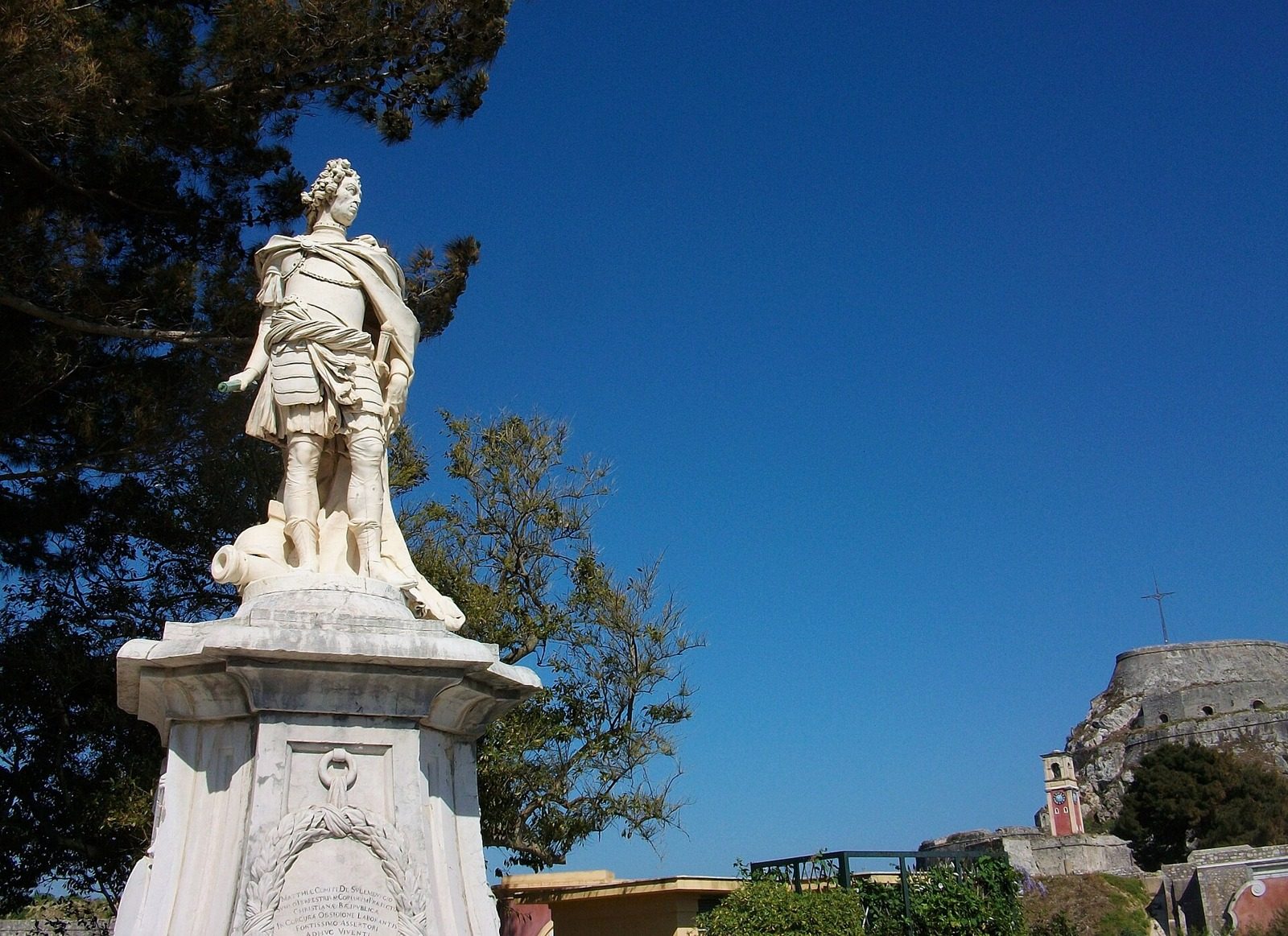
Historians add other reasons for the retreat. Prince Eugene of Savoy had defeated the Ottomans at Petrovaradin on 5 August. There were discipline problems in the Ottoman camp, and autumn weather was coming. Schulenburg himself wrote in his diary that the fortress could not have held out much longer. For Corfiots, though, 11 August remains the saint's miracle. The Venetian Senate honoured both the saint and Schulenburg, whose marble statue stands at the entrance to the Old Fortress.
What happens on 11 August
- The night before: pilgrims arrive from the mainland and the islands. Many spend the night on the Spianada on mats and sleeping bags, to be near the church at dawn.
- Morning: a festive hierarchical Liturgy at the Shrine of Saint Spyridon.
- Then the litany: the relic, standing upright in its glass-fronted casket, is carried through the historic centre. It goes with the clergy, the local authorities, the philharmonic bands and thousands of the faithful. The bells of all the churches ring as it passes.
- Afterwards the relic returns to the church, where people continue to come and venerate it.
The Holy Metropolis publishes the exact programme a few days before. Check it for the 2027 times.
10 August: the Varkarola
On the evening before the litany, Corfu holds the Varkarola in Garitsa Bay. It is a Venetian-style feast on the water, with illuminated boats and music in the bay. In 2023 it took place at 22:00, at the "Mayor's ladder" on the Garitsa seafront. Check the Municipality's programme for the 2027 time.
Where to watch
- The Spianada and the Liston give the most space. The bands are at their best in the open square.
- Around the Church of Saint Spyridon the crowd is dense from early morning.
- For the Varkarola, the Garitsa seafront promenade and the area near the Anemomylos (the windmill) give a good view of the bay.
Practical tips
- Heat: mid-August in Corfu Town is often 30 °C or more. Bring water and a hat, and find shade while you wait.
- Crowds: August is peak season, and the litany adds thousands of pilgrims. Arrive early.
- Traffic: the centre is closed to cars during the litany. Use the blue city buses or walk in.
- Dress: it is a religious procession. If you go into the church, cover shoulders and knees.
- What is open: 11 August is not a national holiday, but it is the town's own feast. Shops in the centre may open later.
- More about the saint: see the Feast of Saint Spyridon on 12 December and our Corfu Old Town guide.
Frequently asked questions
What happened on 11 August 1716 in Corfu?
The Ottoman army lifted its siege of Corfu Town after a violent storm in the night of 10 to 11 August. Corfiots attribute their rescue to a miracle of Saint Spyridon.
When is the litany in 2027?
Wednesday 11 August 2027, in the morning after the Liturgy. The Varkarola in Garitsa Bay takes place the evening before, on 10 August.
Who was Schulenburg?
Johann Matthias von der Schulenburg was the German field marshal who led the Venetian defence of Corfu in 1716. His statue stands at the entrance to the Old Fortress.
Photo: Estàtua de Johann Matthias von der Schulenburg a Corfú by Joanbanjo, CC BY-SA 3.0, via Wikimedia Commons.